
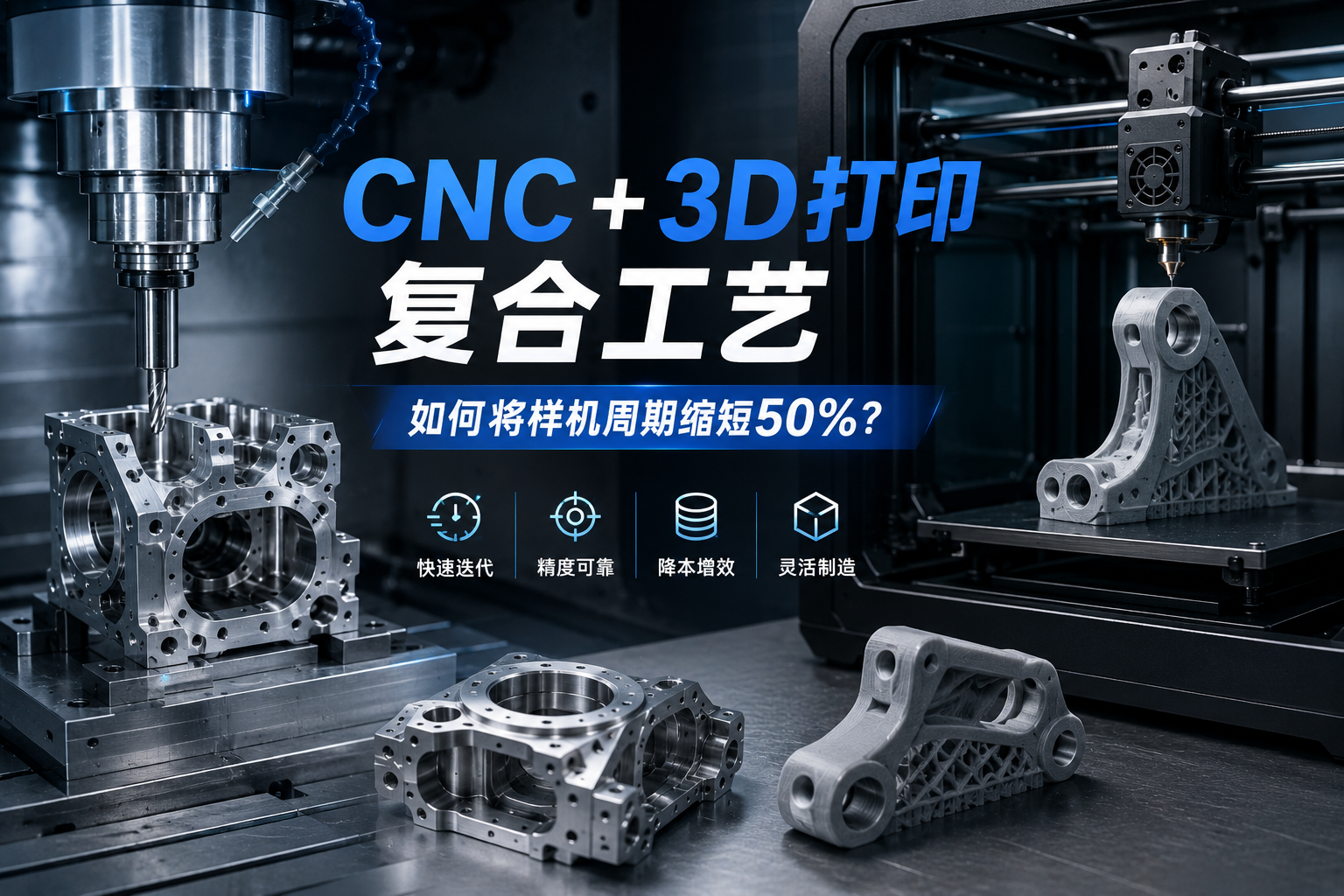
In robot R&D, the prototype cycle largely determines project progress. However, many teams still rely solely on CNC machining, resulting in long lead times, high costs and slow iterations.
“ CNC & 3D Printing Hybrid Process: How to Cut Prototype Cycle by 50% — another important milestone on our smart manufacturing journey. ”
In robot R&D, the prototype cycle generally dictates how fast a project moves forward. Yet many teams still use standalone CNC machining, which leads to long lead times, high costs and slow iterations.
So is there a more efficient solution?
The answer is: CNC + 3D Printing Hybrid Process.
I. Why Standalone CNC Machining Is Inefficient
Traditional CNC machining delivers high precision, but it has notable drawbacks:
- Long production cycle including order scheduling, programming and machining
- Difficult to process complex structures
- Remachining required for every design revision
This approach is ill-suited for the prototype phase with frequent iterations.
II. What Problems Can 3D Printing Solve
Speed is the core advantage of 3D printing:
- Direct forming without mould making
- One-step production for intricate structures
- Ideal for structural and assembly verification
It also has obvious limitations:
- Limited precision
- Insufficient mechanical strength
- Poor surface finish
Therefore, it cannot fully replace CNC machining.
III. Best Practices for the Hybrid Process
Maximum efficiency is achieved by combining the two technologies:
- Structural Verification (3D Printing)
- Quickly check design rationality and assembly fit.
- Functional Verification (CNC Machining)
- Produce critical load-bearing parts via CNC to ensure precision and strength.
- Partial Replacement
- Retain 3D printed parts for non-critical components to save time and costs.
IV. Cycle Comparison & Core Value
- Traditional full CNC machining: 7 ~ 15 days
- Hybrid process (3D Printing + Partial CNC): 3 ~ 7 days
The prototype cycle is reduced by approximately 30% to 50%.
V. Applicable Scenarios
This method works perfectly for:
- Structural parts of humanoid robots
- Dexterous hand assemblies
- Complex assembled structures
VI. Summary
As the robotics industry evolves rapidly, manufacturing methods are transforming.
The era of relying solely on CNC machining is gone.
Hybrid manufacturing has become the key to higher efficiency.
With the combined process of CNC and 3D printing, KuaiZao Workshop has helped numerous clients greatly cut prototype lead times and boost iteration efficiency in real projects.