
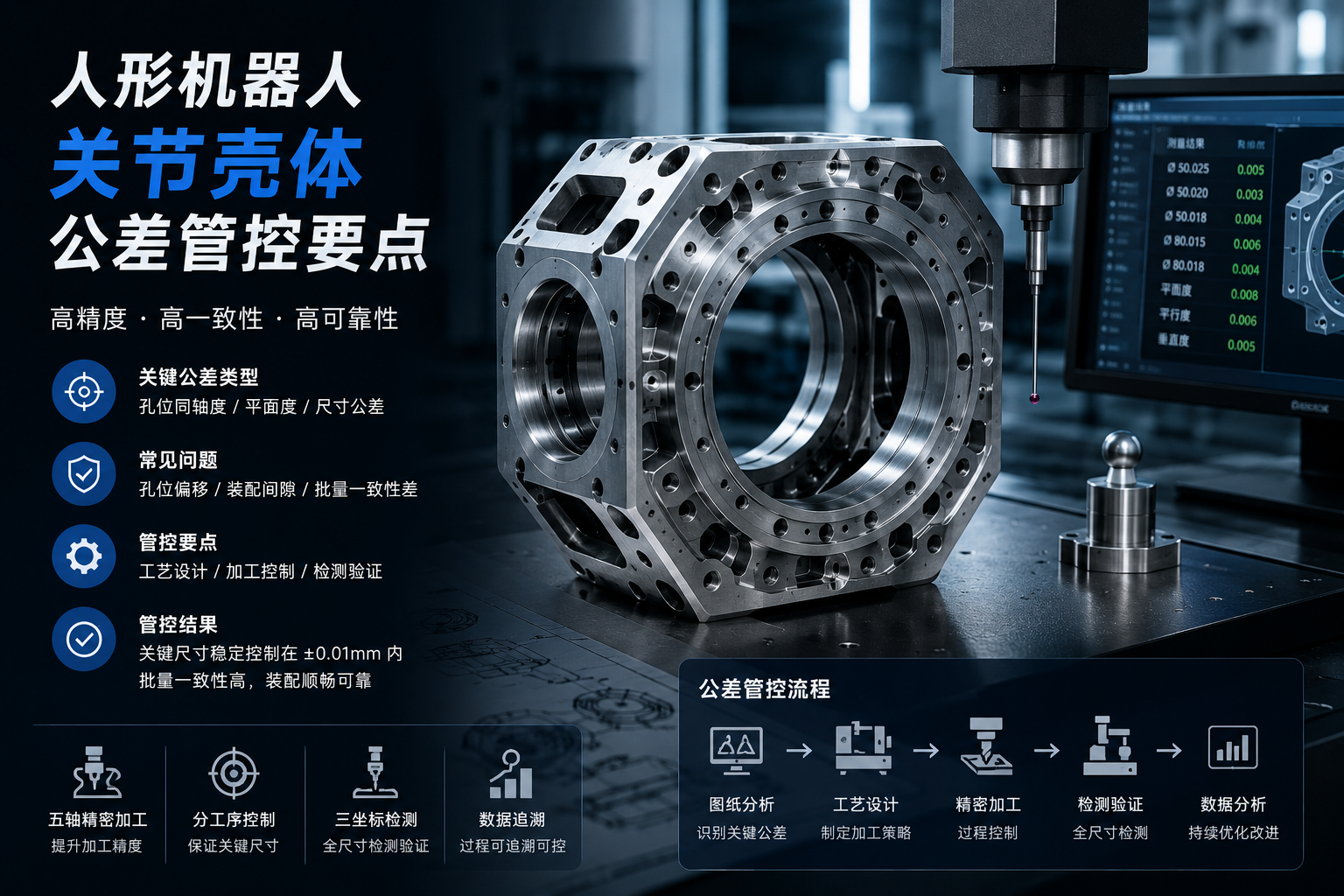
In the structure of humanoid robots, joint housings are among the core components with the highest precision requirements. The main processing challenges lie in tolerance control and assembly consistency.
“ Key Points for Tolerance Control of Humanoid Robot Joint Housings — another important milestone on our smart manufacturing journey. ”
In the structure of humanoid robots, joint housings rank among the core components with the strictest precision requirements. Their major processing challenges are tolerance control and assembly consistency.
I. Main Types of Key Tolerances
- Coaxiality of hole positions
- Flatness
- Dimensional tolerance
These factors directly affect the robot's motion accuracy and service life.
II. Common Issues
- Jitter and stalling caused by offset holes
- Unstable assembly clearances
- Poor consistency across batches
III. Solutions
- 5-axis CNC Machining
- Minimize clamping errors.
- Phased Processing Control
- Machine critical dimensions separately.
- Inspection System
- Full dimensional inspection via coordinate measuring machines.
IV. Outcomes
With systematic tolerance management, the tolerance can be steadily controlled within ±0.01mm while ensuring excellent batch consistency.
High precision relies not only on equipment, but also on mature techniques and professional experience. This is also an important criterion to evaluate the capability of a CNC processing factory.